Showing posts with label Physics. Show all posts

Monday, 30 December 2019

Raman Effect


In this article we will learn everything about the life of Chandrasekhar Venkat (CV) Raman, Raman Effect on Raman Spectroscopy and Raman Scattering in detail. Useful for graduate and undergraduate students.


CVRaman,Raman Effect


Sir Chandrasekhar Venkat Raman, also known as Sir CV Raman, was a Physicist, Mathematician and a Nobel Laureate. Venkat (his first name) was Tamil Brahmin and was the second of the eight children of his parents.


He was born at Thiruvanaikaval, near Tiruchirappalli on 7th November 1888. He was the second of their eight children. His father was a lecturer in mathematics and physics which helped him aspire to careers in the same fields.


Here is how his life progressed:


  • At an early age, Raman moved to Visakhapatnam.
  • Started studying in St. Aloysius Anglo-Indian High School.
  • After his graduation he was selected into government services where he worked for years.
  • In 1917, Raman resigned from his government service and took up the newly created Palit Professorship in Physics at the University of Calcutta at the age of 28.
  • On February 28, 1928, (the reason National Science Day is celebrated in India) through his experiments on the scattering of light, he discovered the Raman effect. C. V. Raman was awarded the 1930 Physics Nobel Prize for this.
  • C.V Raman & Bhagavantam, discovered the quantum photon spin in 1932, which further confirmed the quantum nature of light.


Understanding Raman Effect


Before 1928, infrared spectroscopy was needed to study vibrational & rotational properties of molecules. But after the discovery of Raman Effect, molecules could be excited using visible light spectrum and their properties could be studied more conveniently.


According to Consumer Epic, the Raman effect was first predicted by A. Smekal (1923) and further work was done by Kramers and Heisenberg, (1925) and Dirac (1927). The first experimental evidence for the inelastic scattering of light by molecules such as liquids was observed by Raman and Krishnan in 1928.


It was recognized immediately by Raman that he was dealing with a new phenomenon of a fundamental character in light scattering, something analogous to the Compton effect.


In order to establish its identity, Raman employed a mercury arc and a spectrograph to record the spectrum of the scattered light.


He then made the startling observation that when any transparent substance (be it solid, liquid, or gas) was illuminated by a mercury arc lamp, and the light scattered by the medium was analyzed with the aid of a spectrograph, the spectrum of the scattered light exhibited over and above the lines present in the spectrum of the mercury arc light; either new lines or, in some cases, bands and generally also unresolved continuous radiation shifted from the present line to different extents. The unmodified radiation constituted Rayleigh scattering. Source


Raman Spectroscopy


Definition: Spectroscopy is a branch of science studying the interaction of electromagnetic radiation with matter, with the object of determining the nature of the matter in question. The intensity (power) of this radiation as a function of wavelength, frequency, or energy is called the “spectrum”.


In contrast to other conventional branches of spectroscopyRaman spectroscopy deals with the scattering of light & not with its absorption.


Screen Shot 2020 01 04 At 17.58.49


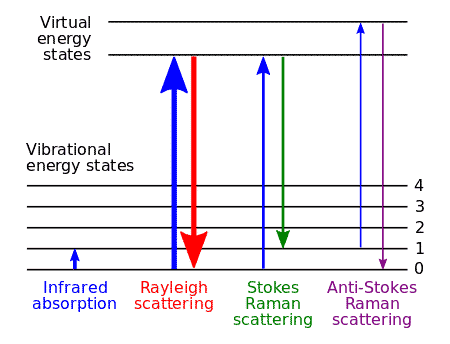
Chandrasekhar Venkat Raman discovered in 1928 that if light of a definite frequency is passed through any substance in gaseous, liquid or solid state, the light scattered at right angles contains radiation not only of the original frequency (Rayleigh Scattering)  but also of some other frequencies which are generally lower but occasionally higher than the frequency of the incident.


The phenomenon of scattering of light by a substance when the frequencies of radiation scattered at right angles are different (generally lower and only occasionally higher) from the frequency of the incident light, is known as Raman Scattering or Raman effect.


The lines of lower frequencies are known as Stokes lines, while those of higher frequencies are called anti-stokes lines.


Raman Energy Level


If $f$  is the frequency of the incident light &  $f'$  that of a particular line in the scattered spectrum, then the difference   $f-f'$ is known as the Raman Frequency. This frequency is independent of the frequency of the incident light. It is constant and is characteristic of the substance exposed to the incident light.


A striking feature of Raman Scattering is that Raman Frequencies are identical, within the limits of experimental error, with those obtained from rotation-vibration (infrared) spectra of the substance.


The Raman scattering takes place due to inelastic collision between photons and electrons. The difference in energy between incident photon and emitted photons generates Raman lines.


Here is a video guide for Raman Spectroscopy by Practical Ninja:


https://www.youtube.com/watch?v=SsIYDEma_cU


Advantages of Raman Effect


  • Raman Spectroscopy can be used not only for gases but also for liquids & solids for which the infrared spectra are so diffuse as to be of little quantitative value.
  • Raman Effect is exhibited not only by polar molecules but also by non-polar molecules such as $O_2$, $N_2$, $Cl_2$ etc.
  • The rotation-vibration changes in non-polar molecules can be observed only by Raman Spectroscopy.
  • The most important advantage of Raman Spectra is that it involves measurement of frequencies of scattered radiations, which are only slightly different from the frequencies of incident radiations. Thus, by appropriate choice of the incident radiations, the scattered spectral lines are brought into a convenient region of the spectrum, generally in the visible region where they are easily observed. The measurement of the corresponding infrared spectra is much more difficult.
  • It uses visible or ultraviolet radiation rather than infrared radiation.


Usage


  •  Investigation of biological systems such as polypeptides and the proteins in aqueous solutions.
  •  Determination of the structures of molecules.


Classical Theory of Raman Effect


The classic theory of Raman effect, also called the polarizability theory, was developed by G. Placzek in 1934. I shall discuss it briefly here.


When a photon interacts with a molecule it will cause the electrons and protons to move and this will induce an oscillating dipole. This dipole will then radiate photons of different frequencies.


It is known from electrostatics that the electric field $ E $ associated with the electromagnetic radiation induces a dipole moment $ \mu $ in the molecule, given by
$ \mu = \alpha E $ .......(1)


where $ \alpha $ is the polarizability of the molecule. The electric field vector $ E $ itself is given by
$ E = E_0 \sin \omega t = E_0 \sin 2\pi \nu t $ ......(2)
where $ E_0 $ is the amplitude of the vibrating electric field vector and $ \nu $ is the frequency of the incident light radiation.


Thus, from equations (1) & (2),
$ \mu= \alpha E_0 \sin 2\pi \nu t $ .....(3)
Such an oscillating dipole emits radiation of its own oscillation with a frequency $ \nu $ , giving the Rayleigh scattered beam. If, however, the polarizability varies slightly with molecular vibration, we can write
$ \alpha =\alpha_0 + \frac {d \alpha} {dq} q $ .....(4)
where the coordinate q describes the molecular vibration.


We can also write $q$ as:
$ q=q_0 \sin 2\pi \nu_m t $ .....(5)
Where $ q_0$ is the amplitude of the molecular vibration and $ \nu_m $ is its (molecular) frequency.


From equations. 4 & 5, we have
$ \alpha =\alpha_0 + \frac {d\alpha} {dq} q_0 \sin 2\pi \nu_m t $ .....(6)


Substituting for $ alpha $ in (3), we have
$ \mu= \alpha_0 E_0 \sin 2\pi \nu t + \frac {d\alpha}{dq} q_0 E_0 \sin 2\pi \nu t \sin 2\pi \nu_m t $ .......(7)


Making use of the trigonometric relation $ \sin x \sin y = \frac{1}{2} [\cos (x-y) -\cos (x+y) ] $ this equation reduces to:
$ \mu= \alpha_0 E_0 \sin 2\pi \nu t + \frac {1}{2} \frac {d\alpha}{dq} q_0 E_0 [\cos 2\pi (\nu - \nu_m) t - \cos 2\pi (\nu+\nu_m) t] $ ......(8)


Thus, we find that the oscillating dipole has three distinct frequency components:


  1. The exciting frequency $ \nu $ with amplitude $ \alpha_0 E_0 $
  2. $ \nu - \nu_m $
  3. $ \nu + \nu_m $ (2 & 3 with very small amplitudes of $ \frac {1}{2} \frac {d\alpha}{dq} q_0 E_0 $


Hence, the Raman spectrum of a vibrating molecule consists of a relatively intense band at incident frequency and two very weak bands at frequencies slightly above and below that of the intense band.


If, however, the molecular vibration does not change the polarizability of the molecule then $ (d\alpha / dq )=0$ so that the dipole oscillates only at the frequency of the incident (exciting) radiation. The same is true for molecular rotation. We conclude that for a molecular vibration or rotation to be active in the Raman Spectrum, it must cause a change in the molecular polarizability, i.e., $ d\alpha/dq \ne 0$ .......(9)


Homo-nuclear diatomic molecules such as $ \mathbf {H_2 , N_2 , O_2} $ which do not show IR Spectra since they don't possess a permanent dipole moment, do show Raman spectra since their vibration is accompanied by a change in polarizability of the molecule. As a consequence of the change in polarizability, there occurs a change in the induced dipole moment at the vibrational frequency.


Further Reading


Thursday, 10 October 2013

The Nobel Prize in Chemistry 2013


nobel prize winners chemistry 2013Classical mechanics is considered to be just opposite to quantum physics in terms of theory and practical models. Classical mechanics, especially Newtonian Mechanics, and quantum mechanics are definitely two fundamental but equally different branches of physics having no significant connection to each other. These completely disjoint subjects were glued by the work of the trio of Martin Karplus, Michale Levitt and Arieh Warshel, the professors of chemistry from the universities of United States of America in decade of 1970s. This way, they have been granted Nobel "for the development of multi-scale models for complex chemical systems" by Royal Swedish Academy of Sciences, after their 40+ years' continuous and fruitful work.

The theory of analyzing the models for complex chemical systems was initiated and proposed by  Karplus and was supported by other two scientists. Modern technology boosted their work later in between 1990s and 2010 and their 'on paper theory' changed into realistic computer models. These computer models, were made to combine the strong and weak points of classical and Newtonian mechanics .


The chemists find impossible enough to explain chemical reactions with the theory of Newtonian mechanics due to the limitations at the particle level, they feel it decently easy to do the same while switching the same to Quantum Mechanics, on the other hand. Karplus and Levitt where determined to combine these two physics branches and they started the public work for it in 1976 by creating an enzyme reaction related computer model. After the computing powers of modern computers were increased, the work of Nobel Prize winner increased and they created and studied several interesting simulations. These computerized models were great enough for the trio to win them a Nobel.

Saturday, 19 March 2011

Jablonski Diagram - Consequences of Light Absorption


All about the Light Absorption’s theory on the basis of Jablonski diagram.


According to the Grotthus – Draper Law of photo-chemical activation:


Only that light which is absorbed by a system, can bring a photo-chemical change.


However it is not true that all the kind of light(s) that are absorbed could bring a photo-chemical change. The absorption of light may result in a number of other phenomena as well.


  • For instance, the light absorbed may cause only a decrease in the intensity of the incident radiation. This event is governed by the Beer-Lambert Law.
  • Secondly, the light absorbed may be re-emitted almost instantaneously, within $10^{-8}$ seconds, in one or more steps. This phenomenon is well-known as fluorescence.
  • Sometimes the light absorbed is given out slowly and even long after the removal of the source of light. This phenomenon is known as phosphorescence.


The phenomena of fluorescence and phosphorescence are best explained with the help of the Jablonski Diagram.


What is Jablonski's Diagram?
Jablonski Diagram


In order to understand Jablonski diagram, we first need to go through some basic facts. Many molecules have an even number of electrons and thus in the ground state, all the electrons are spin paired. The quantity $ \mathbf {2S+1} $ , where $ S $ is the total electronic spin, is known as the spin multiplicity of a state. When the spins are paired $ \uparrow \downarrow $ as shown in the figure, the upward orientation of the electron spin is cancelled by the downward orientation so that total electronic spin $ \mathbf {S=0} $ . That makes spin multiplicity of the state 1.


$ s_1= + \frac {1}{2}$ ; $ s_2= – \frac {1}{2}$ so that $ \mathbf{S}=s_1+s_2 =0$ .
Hence, $ \mathbf {2S+1}=1 $


Spin Orientation on the absortion of a ligh photon


Thus, the spin multiplicity of the molecule is 1. We express it by saying that the molecule is in the singlet ground state.


When by the absorption of a photon of a suitable energy $ h \nu $ , one of the paired electrons goes to a higher energy level (excited state), the spin orientation of the single electrons may be either parallel or anti-parallel. [see image]


• If spins are parallel, $ \mathbf {S=1} $ or $ \mathbf {2S+1=3} $ i.e., the spin multiplicity is 3. This is expressed by saying that the molecule is in the triplet excited state.
• If the spins are anti-parallel, then $ \mathbf{S=0} $ so that $ \mathbf {2S+1=1} $ which is the singlet excited state, as already discussed.


See, since the electron can jump to any of the higher electronic states depending upon the energy of the photon absorbed, we get a series of singlet excited states, $ {S_n} $  and a series of triplet excited state $ {T_n}$where $ n =1, 2, 3 \ldots $ . Thus $ S_1, , S_2, , S_3,  \ldots $ etc are respectively known as first singlet excited states, second singlet excited states and so on. Similarly, in $ T_1, , T_2,, ….. $, they are respectively known as first triplet excited state, second triplet excited state and so on.


Make sure, you are not confused in $ \mathbf{S}$ & $ S_n $.


Monday, 20 December 2010

Radioactive Pollution


The environment is contaminated in numerous ways. Plastic on the land, sewage in the water, carbon in the air. But not every substance is radioactive and not every pollution is radioactive pollution. There is a category of atoms that try to become a stable isotope from its unstable state. This process involves emission of radioactivity. When these atoms are present in the environment, then you can simply claim the environment to be radioactively polluted.


Well, you can see the dirty river, can smell the garbage. Radioactivity cannot be felt. This is the reason that there are many safe places, may be your home, that needs to be checked for the radioactive pollution.


Below is some more information related to radioactive pollution, which you must know.


What is Radioactive Pollution?

Radioactive Substances and nuclear radiations (i.e., alpha, beta & gamma-particles) produced during nuclear reactions, affect our environment adversely and thus radioactive pollution is created.

What are the Sources of Radioactive Pollution?

Low level radioactive liquid wastes, radioactive gaseous wastes & dusts are released during nuclear explosions and are the key sources of radioactive pollution.


The Major Causes & Events that produce Radioactive Pollution


Radioactive waste and sources


Basically, high level, low level and transuranic are the three categories of radioactive wastes. The high-level waste emits lower levels of radiations for a very long time. But initially the emission measured is claimed to be intense. They mainly comprise of the disposal from nuclear weapons.


Low-level wastes are high volume wastes and keep emitting ionizing radiations for a longer time. The cleaning materials from nuclear plants and other radioisotopes from hospitals and laboratories are main examples.


Transuranic elements can be found in both of the wastes, especially from military installations. These are also emitted from plutonium processing.


Nuclear weapons' testing


Right after the start of the atomic age i.e. since 1945, the nuclear weapon testing came into significance. Since then, the weapon bursting has been carried out on the Earth’s surface, under the Earth’s surface, in the atmosphere and hundreds of meters under the water.


Though the isotopes of Iodine (129 and 131), stocks of plutonium and cesium decay fast, they are dumped underground. But, strontium-90 has always been a biggest cause of many health hazards. According to a report to the UN General Assembly in 2000, nuclear testing is the main reason for human exposure to radioactivity which is caused by man.


World War II


After several years from the Hiroshima and Nagasaki atomic bomb combat, researchers from Brazil examined a victim’s jaw. There was an absorption of 9.46 grays of radiation where half of this amount can easily kill a human.


Apart from the human life and ecosystem damages during the war, the radioactive particles and energy so generated got consumed by land, air and water. This happed over a range of several miles.


A couple of years later, the leukemia cases fired up for four to six years. Later, the number of tumor cases increased rapidly since 1956. Though the cities have recovered from the damage and they are not radioactive anymore.


Chernobyl nuclear accident


Due to the rupture in the nuclear reactor a large amount of radioactive substances was released for over ten days. People in the nearby cities were evacuated. But the radioactive substances got deposited and later contaminated the sewage. The agriculture was ruined due to the contamination due to iodine and hence affecting the dairy farming. Even for decades the food crops and milk will remain contaminated with the cesium-137 due to the disaster.


Fukushima nuclear accident


Due to the natural earthquakes and tsunamis in 2011, an accident occurred in Fukushima’s nuclear reactor. Through the air, amounts of radioactive iodine, strontium and cesium got deposited on the ground and in the water.


The land life will get deteriorated because of the Cesium-137 isotope. It won’t decay half the way before thirty years since then. This affected and will affect the stocks, agriculture and people’s health for an unforeseeable future.


Natural contamination


Apart from the human activities, some radioactivity is generated naturally. The sources are gases and minerals that are present in the land. Though they cannot escape, unless there is mining or extraction done. Another example of natural radioactive contaminant is radon gas.


A naturally occurring gas, radon disperses in the environment rapidly and does not affect anyone. But if it enters in the building, it gets trapped. It is odorless, colorless and inert. Where smoking is the biggest cause of lung cancer in USA, radon follows it. Thousands die every year due to the lung cancer due to radon. Getting your homes, offices, schools tested and treated is suggested by the authorities.


Cosmic radiation is one more cause of radioactive pollution, entering the earth’s atmosphere from space. Carbon-14 present inside the human body is generated due to these cosmic rays.


Effects of Radioactive Pollution


  1. The radioactive gaseous wastes are injected into the upper layer of atmosphere where, due to cooling they condense to fine-dust particles and thus Radioactive Cloud is formed. This cloud moves in the direction of the wind, settles down slowly to the surface of the earth & thus pollutes air, water & soil.
  2. The radioactive substances produce energy which is so strong that the living cells are damaged or destroyed.
  3. People working with radioactive elements develop tumors.
  4. Radioactive elements like strontium-90 affects our soil & through this human beings and animals are also affected adversely.
  5. Nuclear explosions which are operated in sea, make sea water polluted. This affects aquatic life.
  6. A patient of Radioactive PollutionAmong the radioactive radiations gamma-rays are the most dangerous, since they have high energy and high penetrating power. These radiations can, therefore, pass freely into the human body, where they lose energy, which destroys the living cells by converting them into charged particles i.e. ions. These ions are chemically very reactive & hence disrupt cell membranes, reduce the effectiveness of enzymes and even damage genes and chromosomes. All these results in diseases like Leukemia & Cancer.
  7. The radiation leaked from reactors damage the health of human beings and animals.


Health Hazards to Humans


Acute Radiation Syndrome


Acute radiation syndrome very rare disease that is due to the high-level radioactive exposure. The effects are nausea and the person may vomit, everything within hours. Sometimes, it simply leads to death in a few days or weeks. But nothing to be worried about unless you know you were not at the nuclear explosion or rupture’s sites. Other low-level issues are bulleted next.


Issues based on the age factor


The fact here is that the factor of age matters with the exposure being constant. Talking about the sensitivity to the radiation is high during the growing age then decreases and after adulthood it starts increasing with age. So, the risk for cancer increases if a child is exposed to certain radiation. It is better if the people over forty or in or less than 20 seconds take good care in staying away.


Radiation and Mutation


The radionuclides that are harmful “ionize” (a scientific word that means it removes an electron from the orbit), which disrupts the DNA of the cells in the human body. Now, the thing is, the cell won’t die but will not work as proposed.


One of the effects of the DNA disruption of the germ cell (for reproduction purposes) is mutation that is the genetic effect due to radiation. Of course, mutation won’t end up having a superficially energetic offspring, but a high risk of hereditary cancer will be there. These effects may be visible until some of the generations.


Radiation and cancer


When the ionization disrupts the blueprint of the DNA of the non-germ cell (responsible for cell growth and division), then the cell starts to divide in an uncontrollable manner. It is too slow, though, for someone to even notice, as it is way different than the cancer caused by other than radiation.


Other than this, it is still an ongoing research’s part to determine that at what age the cancer will show up in a human body after the exposure, and which type. Since, different parts of the body have different sensitivity to the radionuclides.


Effects on the Nature


Effects on wildlife


The different levels in the animal system suffer differently. The higher-level organisms get more affected than insects and flies. Herbivores, especially cattle, graze the contaminated land. That’s how the deposition of Ce-13 and I-131 gets accumulated on the animal tissues in a tragically large amount. These radionuclides enter their metabolic cycles and affect their DNAs (mentioned above; ionizing). This ends up having a mutated animal generation with a higher risk to health issues by just a small amount of radionuclides.


Effects on Vegetation


Effects of radiation on the protectors of nature are worse too. The damage is mostly done due to the increase Ultraviolet waves (the short lengthened) and is directly proportional to the amount of exposure the plant gets. Different parts get effected differently. The stomata stop to stop the evaporation during the increase of radiation. When the chromosomes are hit the reproduction is disturbed, resulting plants in altered shapes, size and health. And, exposure in high amounts simply means deletion of the effected plants.


And what we eat are these plants, and what we ingest are nuclides.


Effects on Sea life


The great sources of nuclear energy and chemical processing i.e. the power plants have been releasing radioisotopes into the water since decades. Few are of cesium, radon, crypton, ruthenium, zinc and copper. Though the waste is released in a “permissible” amount but permissible does not means safe. These radionuclides can be detected in the soft tissues or on the bones of the fishes.


In fact, the sea-weed used in bread preparation was said to have radioisotope of ruthenium. The shells of all our shelled delicacies and the tissues of our favorite fishes are contaminated with radionuclides. Guess, who is dying with the sea food? Are we?


Control Measures For Minimizing Radioactive Pollution


The waste materials produced in the mining, enrichment and fission of U-235 inside the reactor are collectively called Nuclear Wastes. At present most of the nuclear waste is being stored in strong leak proof containers. These will be disposed off whenever a safe method of their disposal is found out in future.


Also read: Coronavirus


The Protective Measures Against Contamination


Decaying period


The decaying period of the high level wastes varies such as the products of fission. It can range from several minutes to few hours. Isotopes of Strontium and Cesium have a slow rate of decaying and take up to thirty years for half-life decay. Whereas, Plutonium-239 takes more time up to 24,000 years for the half-life decay. Now, if a hazardous waste isn’t being processed naturally, can you calculate the harms?


Decontamination


Radioactive material is needed to be removed from one’s body. This will prevent the radioactive substance from spreading from one to another. You can externally remove the contaminants from your clothing, skin and hair. Self-contamination requires a lot of soap and warm water. Take a proper bath if you feel contaminated.


If by any chance a human inhales or swallows contaminants, it should be removed internally. Special medical treatment under supervision is given in such a situation.


The precautions at personal level


If your house is located near a nuclear power plant, then you might need to think about the possibility of contamination. The level of radon gas in your building is recommended to be checked. The radon level should be removed. For those who work with the radioactive material are at great risk. They require protective measures to stay away from radioactive contamination.


The methods at global level


The government of all the nations has set a permissible level to the concentration of contaminants that are released in the environment. Apart from that, scientists suggest dumping the waste in the space (only if it is done super carefully).


The best way is to start using the renewable sources of energy. Giving up on nuclear energy will be a huge step to minimize the radioactive pollution.


These are some of the basic facts that should be enough for us to understand how radioactive contamination went wrong. The humans are still trying to fight with the natural radionuclides. Whereas the man-made causes still top the charts. It is time to be aware and preventive to this lesser known contamination. Agreed, this process is significantly slower, but they say, and I quote, “slow and steady wins the race.” Isn’t the destruction due to some of our mean mistakes, enough gradual to succeed in destroying our environment?


Monday, 16 March 2009

Entropy and Disorder

In science, we look for patterns to discover nature's laws. What is the pattern common to all spontaneous changes? To find a pattern, it is often best to start with very simple examples, because then the pattern is likely to be more obvious. So let's think about two simple spontaneous changes -- the cooling of a hot metal and the expansion of a gas -- at a molecular level and search for their common feature.

https://www.youtube.com/watch?v=ZsY4WcQOrfk

A hot block of metal cools as the energy of its vigorously vibrating atoms spreads into the surroundings. The vigorously moving atoms of the metal collide with the slower atoms and molecules of the surroundings, transferring some of their energy in the collisions. The reverse change is very improbable, because it would require that energy migrate from the surroundings and concentrate in a small block of metal. Such a process would require that collisions of the less vigorously moving atoms of the surroundings with the more vigorously moving atoms of the metal would cause the latter to note even more vigorously. The randomly moving molecules of a has spread out all over their container; it is very unlikely that their random motion will bring them all simultaneously back into one corner. The pattern starting to emerge is that energy and matter tend to disperse in a disorderly fashion.